
Aritzia: Style-On-Demand (TSX: ATZ)
Updated: Jul 4
Aritzia (TSX: ATZ) is a Canadian women's retailer that has embarked on an ambitious US market expansion strategy. Founded in 1984 by Brian Hill, a third-generation retailer, the company opened its first store in Vancouver with the aim of bringing a boutique-style experience to customers who didn’t have access to one. Over the past 40 years, Aritzia has has established itself as a staple within Canadian closets, cultivating a cult-like following, a roster of A-list celebrity clientele, and a customer base spanning three generations.
In this article we’ll be covering the key drivers of its success: it’s unique retail and brand format, disciplined company culture, product-forward approach, and test-and-react inventory model. We will then examine recent developments and opportunities for growth.
Agenda:
Business Model
Affordable Luxury Positioning
Company Culture
Product-First Approach
Growth Strategy
Growing Pains
Conclusion
Business Model
Unique retail format and brand structure: Unlike other apparel brands that are often tied to specific heritage stories and aesthetics, ATZ operates as the parent company to a portfolio of roughly eight "brands”, each with distinct aesthetics, generational appeal, and usage occasions. These sub-brands allow ATZ to remain nimble and adapt to changing trends over its 40+ year history, including entering highly competitive categories like denim and outwear or repositioning for different geographies. For example when the well-established Canadian activewear brand “TNA” failed to resonate in the U.S., ATZ successfully relaunched its activewear offering under the brand "Golden". The family of brands encapsulates the multi-dimensional nature of women's identity: corporate badass, romantic bohemian, cosy homebody etc.
Key value proposition is providing "style-on-demand" for the time-constrained consumer: Brands are merchandised in distinct sections of the store, allowing shoppers to curate purchases more efficiently. Being stylish is work, and -particularly for women- can affect how you are perceived. Finding stylish clothing that fits within your budget can take a lot of time and effort. I have numerous friends who couldn’t care less about fashion, but don't want to worry about looking “uncool” or out of date; ATZ is an easy one-stop shop solution.
Figure 1: Aritzia Brand Portfolio

Source: Retail Boss
Affordable Luxury Positioning
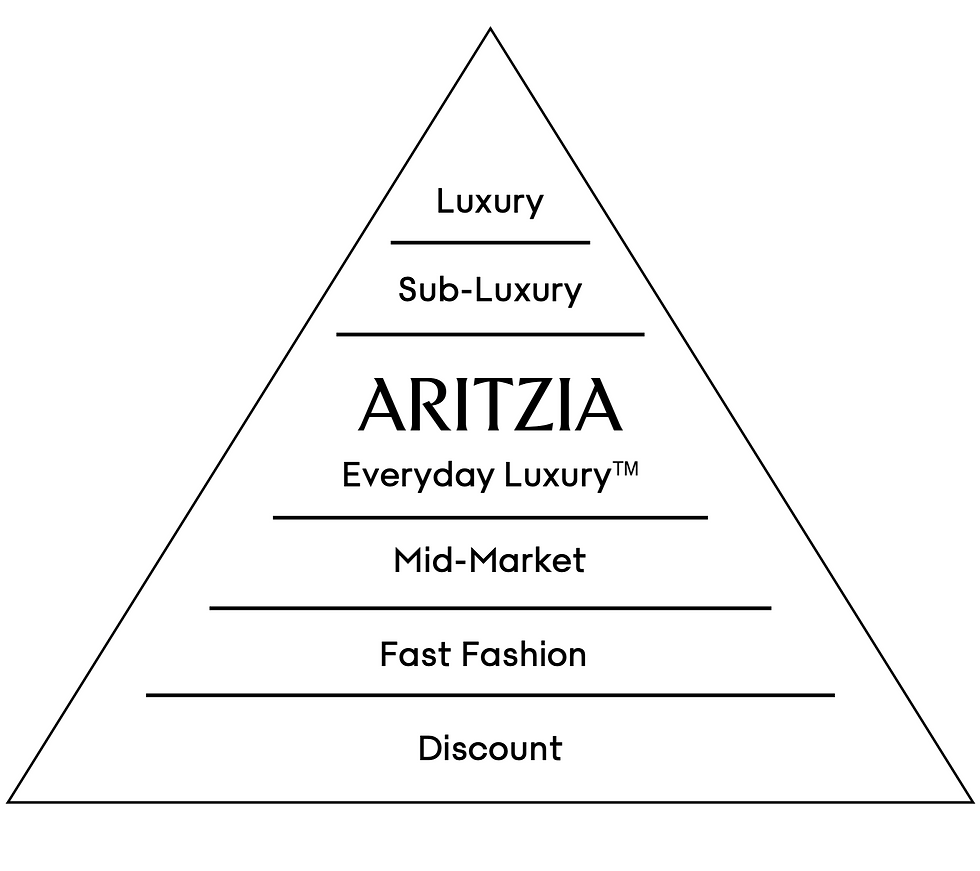
Differentiated positioning as an "Everyday Luxury" Player: ATZ has positioned itself as an affordable luxury brand. The luxury pyramid is a well-known framework in fashion used to describe levels of exclusivity and premium positioning across brands. While the top of the pyramid has remained relatively stable, the lower tiers have been disrupted over the past decade by ultra-fast fashion players like Shein and Temu. Brands that have historically competed in this space, include “casual luxury” player Abercrombie and Fitch (which has since become more accessible), as well as more elevated high-street brands such as H&M-owned COS and Arket, and Inditex-owned Massimo Dutti.
"Lifestyle" retail experiences reinforce premium perception: ATZ stores are tastefully designed, featuring signature elements like the stylish and comfortable “boyfriend” couches, as well as F&B offerings such as the A-OK Café.
High-touch in-store service: Sales associates, referred to as “style advisors”, are highly attentive and productive. Customers are typically greeted customers within minutes of entering the store, with recommended outfit pairing often prepared once they enter the fitting rooms. ATZ fitting rooms famously feature only communal mirrors designed to encourage more interaction with style advisors and boost sales. These same style advisors are also available for personal styling appointments.
Figure 2: Aritzia Luxury Market Pyramid
Source: Aritzia Q3 2026 Investor Presentation
Figure 3: Aritzia Store Interior

Source: Manicproject photography
Company Culture
High-performance culture attracts strong executors with a focus on top-line growth: ATZ is known for its intense, female-dominated (74% of employees), high-performance work environment. Departments are asked to “do it once and do it right” and the company has a culture of incredible execution. A recent Business Insider article described the culture as “toxic”, and not for everyone, citing social pressure around appearance and achieving sales targets.
ATZ is still transitioning from being a founder-led company. External hires complain about a highly centralized culture, and structure that favours narrow specialization over a generalist structure. Retail sales teams are almost exclusively focused on driving sales without the distraction of managing the bottom line - an approach aligned with the current growth mode.
Top sales associates tend to receive more working hours, while shifts are reduced if you don’t meet sales quotas. Sales associates are encouraged to push for personal styling appointments and to keep a list of high-spend clients. Within Canada, this intense sales culture is well-known, and employees tend to self select into the environment.
I've noted that ATZ sales associates tend to fall into a “cool girl” archetype, associates are almost always very stylish and attractive. The power of the cool girl to influence a purchase cannot be underestimated, and represents a significant source of ATZ's intangible value. Women tend to buy from other women, and the ability of the sales associates to embody the aspirational aspect of the ATZ brand is a powerful force.
"It is a high-performance culture. People that come to Aritzia for the first time, if you can make it past six months, you'll be fine. The next big, major milestone is really the two-year mark. If you can make it past two years, again, you're doing fine. It's one of those things where it really weeds out people that aren't bought into the culture. That's challenging because it's 95% female, and it is a highly, highly competitive female environment." (Expert Call)
"I think that's Aritzia's competitive advantage really at the end of the day is that the focus for stores and the focus for retail is, "Drive sales. We will take care of the rest. All you need to do is find a way to drive sales, drive sales, build the culture, etc." (Expert Call)
"What I will add that is like context is Aritzia is an organization that prides themselves on two main points, highly centralized and highly specialized. Highly centralized, meaning there is no decision that is made at the store level that isn't approved from the support office level and vice versa. Everything is taken out of the hands of our store teams." (Expert Call)
"There is a higher price point for the quality of the goods that we're making absolutely. With that being said, it's also a situation where from a total head count standpoint, I know that it cost us more in creating that product and all of that because we have a higher head count.. in that highly specialized model, you don't have generalists. Yes, there are more people that are touching every aspect of the business. Again, being an organization that focuses very heavily on top line, I would say that that's just a general rule across the entirety of the organization is bottom line is not a huge focus for Aritzia at times. It's top line." (Expert Call)
Product-First Approach
Strong emphasis on product-design optimizes for true, everyday wearability: Design ethos is deeply embedded in ATZ’s vision, with leaders referring to ATZ as a “design house”. “Aritzia means style, not trend, and quality over everything…We obsess over proportion, fit and that just-right silhouette. From hand-painted prints to the art of pocket placement, our innovative design studio considers and reconsiders each detail to create essentials you’ll reach for again, and again, and again.” (2025 10K) ATZ follows style, instead of aspiring to be a true fashion brand. The product team pays careful attention to signals within the fashion environment of trending silhouettes, cuts, styles, and then designs accordingly for everyday wearability. Feedback loop of sales signals and data then informs the team so they can produce accordingly.
The product development cycle tends is longer than that of most fast fashion players and traditional apparel retailers. Products are typically developed 10 months in advance, compared to the retail average of 6-9 months, and far longer than Zara's 2-3 weeks design to shelf cycle.
“I still see so much upside in the market for what they're providing to a consumer that just nobody else is providing. I think if ZARA decided to pay more attention to quality and invest in fabrics and really care about fit, would that be concerning? Yeah, but I also think that they can't really do that and operate the way they do with being quick on track. I just think that you can't really do both. You have to pick a side because proper fit takes time and nice fabrics have a long time. They just do. It's just the way the world works.” (Expert Call)
"I think secret sauce, they have fundamentally and a philosophy around developing quality product. They use really good fabric. They have a high attention to fit in detail. And so, the product is not something you buy that you're just going to get rid of next season. It's something you're going to have in your closet for multiple seasons and multiple years." (Expert Call)
Former CEO and founder Brian Hill was highly involved in the design process, known to review all of the core products. In his current, more limited role he is almost exclusively focused on product innovation, including developing partnerships with brands: Nike, Adidas, G.H. Bass, Sperry (all which launched ATZ-exclusive SKUs). He has emphasized the importance of protecting creative talent, with creative teams representing ~5% of the workforce, down from 20% historically.
Attention to cut and fit strike a balance between fashion and everyday wearability. The photo on the left is from French luxury brand Céline which is well-known for its “intellectual, feminine minimalism” and the right from ATZ’s workwear – a category which is strong for them. Here you’ll notice the silhouettes from Céline are a lot bolder, with ballon-like legs, and dramatic cuts compared to the straighter, and more classic tailoring of ATZ’s workwear.
Figure 4: Céline Resortwear 2017, Aritzia Wilfred Generation Blazer
Specific product lines often “blow up” and drive both revenue and brand awareness. Items such as the Effortless Pant, The SuperPuff, Sweatfleece, and Babaton wool coats, have become multi-year franchises, that are beloved both on social platforms and celebrities alike, including "It girls" like Blake Lively, Meghan Markle, Kendall Jenner, and Sabrina Carpenter. Iconic items are often available in multiple materials, colours, lengths and fits e.g. Effortless pant in 34 distinct styles (excluding colour varieties) on the app. Management has disclosed that no single franchise accounts for more than 10% of revenue, highlighting the company's ability to innovate across multiple categories. A rough product mix of 50% classic styles and 50% new items helps ATZ mitigate the fashion risk that is inherent in apparel retail.
Strong focus on material composition of key items: As consumers become more conscious of value, a growing trend is evaluating clothing materials and the use of natural fibres: such as wool, cotton, silk and linen. ATZ’s materials usage is a mixed. Experts note that Aritzia operates with lower gross margins than competitors at around 40% and has invested heavily into premium materials for key categories like outerwear.
Items their leading categories like winter coats are known to use the same fabric as luxury brand Max Mara (known for their $2,000+ winter coats), while The SuperPuff offers strong value relative to comparable down jackets - leading Canadian consumers to buy multiple colours and lengths. "If you think about their outerwear, they're using the same fabric as Max Mara in their coats. So, they're using higher quality fabrics than I think a lot of their competitors," (Expert Call)
"[Quality] varies drastically by category. You can buy a sweater and wash it once and it disintegrates. Their Super Puff and their tailored outerwear is the best value in the market for sure, especially at the price point. It varies drastically, which I think is also a risk to their business." (Expert Call)
Some categories rely more heavily on synthetic materials. While ATZ has tried to premiumize these materials (e.g. Crepette with marketing language such as “one-of-a-kind Japanese fabric” and “never wrinkles”), there is a risk that consumers may begin to question the value proposition if synthetic usage becomes too prominent.
Figure 5: Material Searches by Fabric

Source: Google Search Trends Data
Data-driven decision making in inventory management: ATZ pays careful attention to data signals through a test-and-react model. The team measures early market signals to determine production quantities for items. ATZ also has high pricing power, and is known to rarely offer discounts on items ( e.g. The SuperPuff was only discounted 10% during Black Friday). Discounting is primarily used to clear inventory, rather than as a customer acquisition strategy.
“And it’s not rocket science; I think anyone who knows Aritzia speak about it. It’s a test and react business. I think the business has been built that way from the beginning. It’s harder for other businesses who are not test and react to get into a chase model. It’s like they’re not used to working that way, it’s not how their business was built. And that’s how they’ve been from the beginning. So, they take less risk in the upfront, in an initial order, quality on a new style, and then they resale, and then they react, and then they chase into it. And that’s part of why it helps mitigate the risk because you’re buying inter-stack after it’s proven. You’re not going to be right every single time now, but you’re righter if you’ve read it first and then you react and you chase into it in ancillary season.” (Expert Call)
“Yes, Aritzia loves number and metrics. So, they’re looking at all the things to understand if sales are off” (Expert Call)
Growth Strategy
ATZ is known for its highly disciplined and measured approach to expanding its footprint. The team is extremely selective when choosing prime locations. As founder Brian Hill mentioned in an interview: “Open in the best possible locations you can because if you then fail, you know it’s because you’re shitty,” (Retail Council of Canada's Sept. 25 Retail West Conference). Despite investor pressure, annual targets for store openings and repositions amount to only 12-14 boutiques per year- an approach management has indicated will not change.
The most reliable driver of growth has been U.S.-focused store openings and repositions. In 2022, the U.S. became ATZ's largest market. In the 2025 fiscal year the U.S. market accounted for 58% of net revenue and grew at 31% year over year.
The current store mix is 71 boutiques in the US compared to 68 in Canada (Q3 2026) with significantly runway for growth. Management's latest guidance suggests a potential of 180-200 in the U.S. stores, up from the previous estimate of 125. The next few years will be a key test of ATZ's operating model and its ability to scale in the US, where it remains under penetrated.
The payback period for their stores is short- typically 12-18 months, with some locations outperforming and paying back in under 12 months. Repositions generally focus on increasing store square footage while simultaneously growing sales.
There have been rumours that ATZ is exploring potential locations within the U.K. The last Investor Day was held in October 2022 for the '23-27 timeframe I have reason to expect that international expansion will be an important topic for the next 5 years of growth.
ATZ remains underdeveloped in Marketing, and is still ramping up brand awareness with the aim to become "famous" in the U.S.: Retail margins are typically tight, yet Aritzia has grown while keeping marketing spend in the low single digits as a percentage of sales. The company only launched basic digital marketing in Q1'25, which included channels such as search, social, and paid ads. Certain items like The SuperPuff have found virality organically on TikTok. Momentum is expected to accelerate as brand awareness increases in the US.
"Like they're not a marketing forward organization. I think they're shifting to be that way, but their business was based on building brand by opening stores in great locations and having customers discover them. And I think that has shifted over time. And I think to compete in today's world in the apparel landscape, you must have the first strategy, but you also need the second. And I think they've come around to that." (Expert Call)
Growing Pains
The past few years marked by rapid growth and growing pains: During COVID, online sales surged, doubling to over $2.2B in 2023 from $980M in 2020. Several inventory-related decisions made during this period had a significant impact on ATZ's stock price.
In 2022 and 2023 ATZ struggled to meet demand, management responded by concentrating inventory on client favourites and pulling forward inventory orders to avoid freight risk. In 2023 inventory ended up arriving earlier then expected, flooding distribution centers and increasing product costs.
In 2024 ATZ shifted its product mix back to its standard operating model - a 50/50 split between new items and client favourites. The company spent much of 2024 working to reduce inventory levels, with normalization achieved by Q3 2025, when inventory growth realigned with sales growth. This shift in SKU mix is also reflected in the product assortment: the number of products doubled, while the number of SKUs per product declined dramatically.
The stock price has been volatile over the past couple of years, declining during the peak of inventory issues Q1-Q4 2023, before rebounding in Q1 of 2024
Figure 6: Aritzia Inventory Days YoY % Chg

Source: Aritzia Investor Relations 10Q
Figure 7: Aritzia Online SKUs

Source: Goldman Sachs Research
Figure 8: Aritzia Stock Chart

Conclusion
At its core, what differentiates Aritzia from other fashion retailers—and is that advantage defensible? The past few years have made it clear that owning Aritzia comes with real risk: exposure to fashion risk, economic cycles, and the operational growing pains of a scaling business. Margins are generally lower than peers, and missteps—such as the inventory imbalance in 2022—can weigh on performance and the stock for extended periods.
And yet, I still find the business compelling.
A useful comparison is Costco: a retailer deeply committed to everyday value, often at the expense of margin, in order to be the preferred choice for its customer. The economics that are shared with the consumer reflects in the extremely productive sales per square footage and loyal membership base. I believe that Aritzia is similarly deeply focused on delivering value to their consumer. They do the work: providing curated, style-driven product for women at an accessible price points. Prices are reasonable for the quality they deliver, and their products consistently feel like good value for money: this dynamic builds trust and drives repeat purchases.
Furthermore, while maybe less exposed to the hyper-growth associated with more trendy or trend-leading brands (such as in the athleisure categories), their disciplined and data-driven approach to delivering style to the consumer, I believe, is a timeless value proposition. This positioning has the potential to drive durable, and stable growth in the long term.


