
Reformation: Cool Girl Confidence (NYSE: REF)

It was impossible to have been in a fashion girlie in the 2010’s and not have heard of the cult-brand Reformation. In June, the “cool girl” women’s apparel brand submitted a S-1 filing for an IPO (NYSE: REF), making it the first apparel brand to go public since 2023. Widely regarded as a bellwether for Wall Street’s appetite for apparel stocks, this IPO will be closely watched as other privately held apparel brands consider their options.
In this article I will do a deep dive on the brand and cover the following topics:
· Consumer Value Proposition: Making You Look Good
· Product Strategy: Expanding Across Categories
· Consumer Segmentation: Not Just a Millennial Brand
· Business Model: Data-Driven, Sustainable Fast Fashion
· Growth Strategy: Store & Market Expansion
· Conclusion
Figure 1: Value of Apparel IPOs

Source: Financial Times
Consumer Value Proposition
Making You Look Good: I speak a lot about how all consumer brands provide emotional benefits, as well as functional, ones to the customer. Ref, as it is referred to colloquially, focuses on instilling confidence in its consumer “84% of Active Customers say that wearing REF makes them feel confident” (S-1 2026). Through a combination of flattering designs and the right “it girl” backing, the brand has built a loyal following as a “cool girl” brand.
REF combines vintage and modern aesthetics in clothing with a timeless, feminine, and flattering look. The ethos of flattering clothes is emphasized in interviews with founder Yael Aflalo: “‘The reality, of course, is that most people do want to wear clothes that make them look good, and most clothes do not make them look good. ‘They’re either too androgynous, or too revealing, or very feminine, and not as focused on fit for a healthy, normal-sized body,’” (Puck 2024)
A lot of REF designs fall into the category of IFYKYK (“If you know, you know”) and signal a layer of sophistication and aspiration. “I’m a savvy, grown-up consumer choosing quality and good taste, […] I’ve made good choices in my professional life, but I’m still laid-back and cool.” (New Yorker 2019)
REF is well-known as a celebrity favorite, spotted on the likes of Taylor Swift, Hailey Bieber, Jennifer Lopez, and younger celebrities such as Olivia Rodrigo and Kaia Gerber. Strong word of mouth is indicated by the brand’s high reliance on unpaid channels for customer acquisition, which accounted for 75% of new direct to consumer (DTC) customers in 2025 (S-1 2026).
Product Strategy
Expanding Across Categories: REF is “famous” for its dresses, which represented ~60% of its DTC revenue in 2021. The company has successfully expanded into other categories, including denim (2017), shoes (2019), handbags (2023), and jewelry (2025). Dresses now account for ~30% of the business. Shoes and denim are prominent categories, each representing ~10% of the business, while tops, sweaters, and denim grew at a 36% CAGR over the past 3 years. Denim is an impressive category for REF to break into (its $1 SKU is now a jean), as the category is highly competitive and contains several specialist players. Here REF is priced below the market for designer jeans. Its styles start at <$200, while a designer pair is priced closer to $200-$300.
Previously REF was known as a destination for “occasions”. I have reason to believe REF was an early leader to the growing wedding guest dress category, which has continued to boom post-Covid. I’ve written before about how the trend of wedding guest apparel continues to grow in relevance, becoming a high-pressure, multi-outfit cycle fueled by social media, and representing a significant portion of the annual clothing purchase budget. According to ThredUp data, these outfits represent $550 - $820 of spend per look with the average retail price for a wedding guest dress on REF ranging from $250 - $1,400. Public single-brand challengers have been limited in this space: while Abercrombie (ANF) & Aritzia (ATZ) (quietly) launched collections here, their product range is hardly comparable.
Management pays close attention to whether repeat orders include cross-category purchases, as well as the “acquisition” product category by generation. Successful cross-category revenue expansion has been impressive, as REF made the shift from occasion to everyday dressing.
Intimates and Lingerie has been cited by surveys as categories that customers are interested in. Although I believe this could drive cross -category purchases among loyalists, lingerie is a category dominated by strong, specialized and competitive players: privately held SKIMS and VSXY which is currently in a turnaround phase.
Figure 2: Key Occasions of Wear

Source: Reformation S-1
Figure 3: Wedding Guest Category

Source: Google Search Trends
Choiceful Iteration Across Designs and Trends: REF can hedge itself from fashion risk because of its continual usage of proven and well-loved designs. 90% of DTC revenue comes from styles that are derived from shopping patterns and feedback. REF takes best-selling items and evolves them into a family of products across colors, fabrications, and seasons. One example is its Carolina skirt, which turned into 14 successful styles. This is similar to the strategy Aritzia (ATZ) uses for best-selling designs like the Effortless pant.
Figure 4: Split of Net Revenue by Product

Source: Reformation S-1
Figure 5: Carolina Design

Source: Reformation S-1
Consumer Segmentation
Not Just a Millennial Brand: REF has been focused on expanding its core customer base outside of millennials. According to its July 2025 Customer Survey, nearly 20% of new customers were under the age of 25 and nearly 20% of new customers were over the age of 50.
Business Model
Data-Driven, Sustainable Fast Fashion: The team tests styles twice weekly on the website and once weekly in-stores to assesses demand before chasing best-sellers. The product development cycle is very rapid, with only 60 days required for product reorders to reach the distribution center. This is enabled in part by a factory and distribution center located in LA. The supply chain enables REF to be incredibly responsive to cues from consumer data. For example, when Jennifer Lopez was spotted in a REF dress on her honeymoon, the team was able to produce the fabric, which was not on hand, in less than 3 weeks and respond to preorder volume. The “drop” model of releases also keeps customers continually visiting the site for new styles and creates the allure of limited availability. REF operates at high gross margins of 60-64%.
Reformation has long been touted as one of the leaders in bringing “sustainable” fashion into the mainstream. While I won’t go into the details of its sustainability commitments, I would say that its “drop” model and is considered a core component of its sustainable business: “Yes some of the inputs are more expensive but being a sustainable business also means producing what you need so you can discount less.” (Hali Borenstein, Semafor 2023)
From 2021 to 2025, 80% of DTC revenue came from full-price sales. REF has less exposure to merchandise discounting and inventory challenges due to its fast production cycles and data-driven decision making. Contrary to other retailers, its peak season is in Spring / Summer, rather than the Holiday period.
Designs and style are highly rated, but quality is a hit or miss, especially for the price charged. There are many reviews complaining about a lack of lining in dresses, 100% viscose material composition, and durability of the knitwear. When I purchased a cashmere sweater, the quality was appalling for the price. Although it had a great flattering cut that easily got compliments, the cashmere quickly started shedding as soon as I wore any undergarment underneath.
DTC driven business: 90% of net revenue comes directly from DTC channels. REF has a selective wholesale strategy which is primarily used to drive brand awareness and to reach new markets. Approximately 11% of the 2025 cohort was introduced to REF via wholesale.
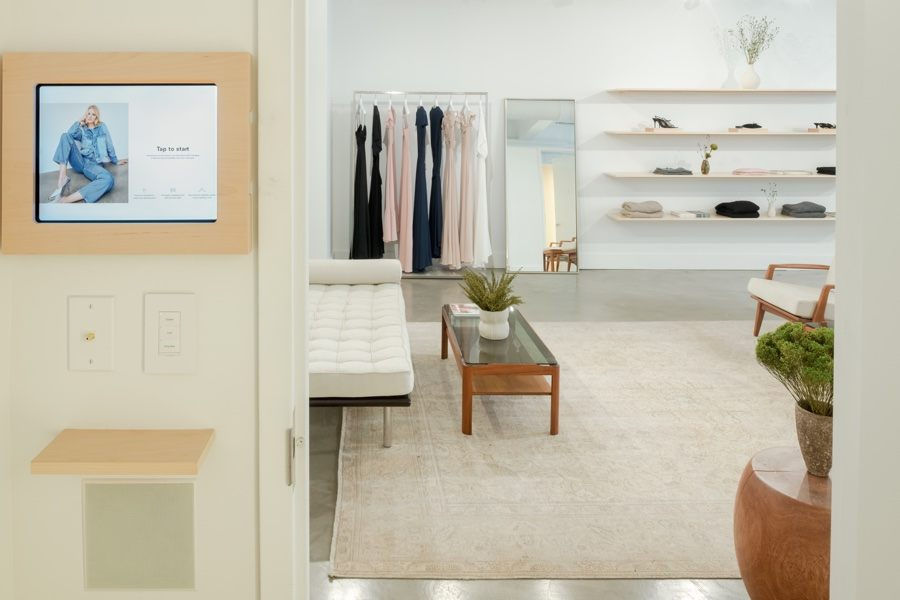
Unique, Technology-Forward RetailX Format: REF’s in-store format is inspired by the Clueless closet, from the 90’s cult classic film known for its fashion, and is present in about 75% of its stores. Management sees 8.5% higher average order value and 270 basis points higher conversion in RetailX locations. Clothing is displayed in “sample-only showrooms” which enhances the brand’s premium perception and is a format typically seen in designer-level clothing brands.
Touchscreens inside the changing room allow customers to browse different styles and select alternate sizes and colors. Through this technology, REF can gather real-time data on product engagement and fitting room conversions.
Figure 6: Changing Room Technology
Source: Boston Magazine
Sustainability as a Consumer Value Proposition: Generally speaking, sustainability is something businesses are expected to integrate within their business model, without charging customers a premium. While I won’t go into the complexities of sustainability within fashion, materials continue to be at the forefront of the discussion. I’ve written a little in previous articles about how materials have been a focus for “premiumization”, but there is also a burgeoning trend in “wellness” related to sustainability. A recent Business of Fashion article from May 2026 cited how brands are pivoting to wellness marketing, which is more relatable to consumers than vague corporate sustainability goals. Synthetic fabrics are tied to microplastic pollution and human health concerns. In 2025, only 10% of the REF’s fiber use was synthetic, with 7.5% using deadstock materials, or excess materials leftover by other fashion houses. REF has committed to reducing its virgin synthetic usage to 0% by 2030.
Growth Strategy
There are a couple of factors that make me nervous about REF’s expansion, as I’m seeing signs of lower growth potential rather than acceleration.
For comparison, I’ve selected the clothing retailer Aritzia (ATZ), which has similarities in the demographics they target. ATZ is also rapidly expanding within the US, with a similar store count to REF. From demographic research by GS Data Works in 2025, it identified that the median income ATZ targets is about $90K annually, which is similar to REF’s target of 67% of customers coming from single or shared incomes of over $100K a year. ATZ is also known to target across three generations, an area which REF is just starting to source their growth from (40% of new customers in 2025 were either Gen X or Gen Z).
One important thing to note is ATZ’s price points for key items are significantly lower than REF’s. Jeans start at $110 vs $178 for REF, dresses have a narrow range of $68 - $188 vs. $90-$980 for REF. ATZ generally operates at 50% margin (Q1 2027), lower than REF's 60% (FY 2025)
Figure 7: Comparing REF and ATZ across key growth metrics

Source: Reformation S-1 Filing, Aritzia Investor Relations
Focused on Store & Market Expansion: Canada and Europe have both been cited as markets for market expansion. Management has also mentioned its intention to double the store count in the next 5 years and noted that REF currently has stores in only ½ of the top 50 metropolitan cities by population in the US. One thing to watch out here is that REF has already been seeing declining momentum with store openings, where Net Revenue / Store, # of Active Customers / Store (people who bought at least 1 item in the past 12 months) and Search Traffic / Store has been declining and has not been keeping pace with store growth. I would argue that REF is a more mature brand in terms of awareness and may not be benefit from the halo effects on continual store expansion. This stands out in stark contrast to ATZ which is accelerating across all metrics.
Low-Frequency Purchase Business: The AOV in 2025 was $315. Meanwhile, DTC net revenue per customer was about $422. This indicates that REF is a low-frequency store, with consumers purchasing only about 1.3 times per year. While the S-1 speaks to price points being broad ranging from $40 - $1,500, most of the items which REF is “famous” for are expensive: their Clara Cardigan starts at $168, best of dresses start at $248, the Cary Jean starts at $178. It is not surprising that high-value customers, defined as customers who spend more than $1,000 per calendar year, accounted for 40% of net revenue.
Management states that it has less than “1% customer penetration of the core U.S. addressable market today” (S-1 2026). However, I would argue that they are likely much more penetrated due to its price points. At the end of the day, it’s an aspirational rich girl brand. The highest quintile of US households spends an average of $1,472 on women’s apparel categories in 2024, and it is highly unrealistic that REF market size is as large as even 27 million customers of the top quintile.
Conclusion
In conclusion, REF is a business that sits at the “higher” end of a fast fashion brand and has leveraged its data-driven business model to deliver on a sustainability promise. The trust it builds with their consumer is contingent on flattering, on-trend product and the feelings of aspiration that come from being able to afford their pieces.
While I would need to see the IPO pricing to determine whether it is reasonably valued, I would say this business is entering in the market in a rather mature phase, where we should expect to see modest growth.


