
Quince: Democratizing Everyday Luxury (Private)
Updated: Jul 1

Can you have your cake and eat it too? With my own cost of living creeping up with the impending financial demands of adulthood milestones i.e. weddings, housing, babies, etc. I find myself drawn to the new slew of “affordable luxury” retailers. The delectable promise of affordable luxury is hard, literally to ignore – a constant feed in in my digital media advertising diet.
The challenge of passing down value to consumers, while also preserving standards of quality and the consumer relationship of trust, is one that few retailers have done successfully and at scale. More than just a branding exercise, it’s a true challenge of operational excellence across the entire value chain. Quince (Private Company) is an apparel player to watch. In 2025, it reached the milestone of $1 billion in annual sales, and in March of 2026 Quince announced a $500M round in a Series E funding, bringing the total company valuation to $10 billion.
In this article I’ll be covering the following agenda:
· Quince’s Business Vision: Built to Disrupt
· Consumer Value Proposition: Affordable Essentials with a Luxury Twist
· Supply Chain: Manufacturer to Consumer
· Product: Walking the Fine Line between Dupe and Design
· Growth Strategy: Explosive Category Growth
· Conclusion: Scale as Moat
Business Vision
Built for Industry Disruption: Quince was never supposed to be just another fad-brand. The founder: Stanford-educated, private equity-trained (L Catterton) Sid Gupta has his sights set on how to become one of the biggest retail companies in the world. The two strategic principles he identified: supply chain disruption and discounts for the consumer.
Quince aims to be a “‘curated marketplace of factories’ that democratizes mass-access to high quality apparel, home goods, and jewelry at deeply discounted prices…because ‘quality shouldn’t be a luxury’” (Sid Gupta, Forbes 2021).
"'The strategy for this then came from really a few observations. The first observation was that if you look at the last a hundred years, the biggest retail companies in the world had two things in common: One is that they had some supply chain innovation,' and secondly, they were organized and operated 'in some sort of way to give people more value or discounts, right?...So, we said, Okay, those are going to be two guiding principles.’” (Sid Gupta, Forbes 2021).
Figure 1: Reported Revenue Growth
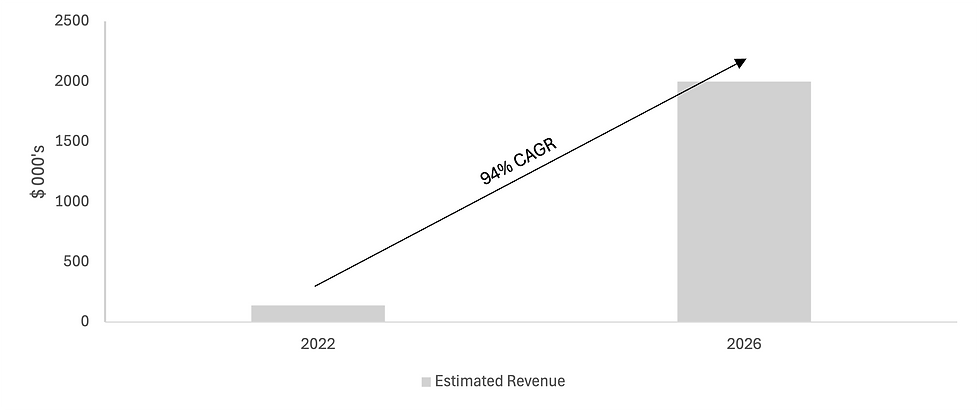
Source: Google Trends
Consumer Value Proposition
Affordable Essentials with a Luxury Twist: It all started with a $50 cashmere sweater. A viral loss-leader product that put Quince on the map. The key value proposition Quince offers consumers is luxury essentials at unbeatable prices. Quince’s target consumer skews older than millennial, with Gen X reportedly being the largest repeat customers.
Materials forward-approach: I wrote about how materials-forward marketing continues to be a trend in apparel retail in my article on Aritzia (TSX : ATZ). Quince has leaned heavily into materials-led products as a method of reinforcing its affordable luxury positioning, with its start in Cashmere, and expansion into other categories, from bedding and towels to caviar and superfoods.
Importance of Hero SKUs: similar to Costco which has its iconic Rotisseries Chicken and $2 Hot Dogs. Items like Quince’s $50 Cashmere sweater is an important loss-leader SKU that attracts consumers to the brand and acts as an marketing acquisition tool, an item that helps to build “cult-like” status for the brand.
Quince aims to provide marketplace benefits: deeply discounted and competitive pricing but without the “endless shelf”, vetting goods for quality and providing a more curated shopping experience. "'…all the marketplaces focused on ‘endless shelf’ — Let’s give more and more choice to the customer because that’s going to be better. And what we realized is that’s been paralyzing for the customer.'" (Sid Gupta, Forbes 2021)
Quince borrowed from D2C brands like Everlane, with a focus on “radical transparency” comparing their product costs to traditional retail. Each of the products listed on their website are accompanied by a detailed graphic breaking down the cost of production and the margin Quince is taking for the product.
Figure 2: Radical Transparency with Unit Cost Breakdown

Source: Quince Website
Supply Chain
Manufacturer to Consumer Supply Chain: Quince leverages technology to simplify the supply chain and deliver value to the end consumer. Borrowing strategies from ultra-fast fashion players (Shein), it connects factory supply of quality goods directly to consumers and partners with factories to utilize their excess capacity. Quince's M2C supply chain is ambitious but likely not realistic as the company scales.
Forecasting structure connects in real time to factory API’s and production planning is managed down to the SKU and size level in weeks vs quarters. Products start with small-batch production for the opening order; a restocking schedule is then mapped out based on demand. This model eliminates a lot of inefficiencies with forecasting and overstock (the target overproduction rate is below 5%), where typically in retail models’ production volumes are forecasted months in advance, and 30-40% of apparel is thrown into the landfill.
Quince selects “higher-quality” factories that are known to already produce more up-market goods, and guarantees the use of year-round excess capacity and scaled production. Their network of over 100 luxury manufacturers also holds inventory and can drop-ship direct to the consumer.
M2C supply chain is not built to last. In June 2025, Quince opened its first 105sq foot fulfillment and distribution center in Carneys point New Jersey and announced plans to expand. Logistics are likely needed especially as the company expands to more complex categories like furniture and manages return policies.
Quince has had a few pop-up stores in 2026: a furniture pop-up in LA, linen pop-up in Toronto, and jewelry pop-up in NYC. It invests a significant amount in digital marketing, but long-term it’s highly possible that opening physical stores will yield better Customer Acquisition Costs (CAC) for them. The omnichannel retail experience is a route almost all D2C brands have eventually moved into, indicating the unit economics pay off.
Figure 3: M2C Supply Chain

Source: Quince
Product Strategy
Curated selection of everyday products, with controversial “dupe” reputation: Quince deliberately select products with staying power that can sell next season and avoids the use of discounts to sell excess inventory. Product design is the category where Quince has run into the most controversy. A lot of their products are very close dupes to designer luxury products. The way I view it, they outsource the design and market validation to designer brands, only really taking product concepts to market once they have been “market proven”.
Quince is similar to ultra-fast fashion player Shein in that it uses search results to guide product development. Quince uses proprietary technology that scrapes the web for search results and reviews and looks for best sellers at other companies that are known for distinctive everyday luxury products. E.g. Away for Luggage, Jenni Kayne for Sweaters, Cuyana for Bags. Comparables are often called out explicitly in product comparisons.
The company response to accusations of copycatting: “There’s only one distinction between us and Kirkland: We try to make our product better than the comparable.”(NY Times).
While the products offer tremendous value, reviews indicate that the goods do not measure up to the same quality as other true luxury brands. Marketing buzzwords: Turkish Towels, Italian Leather, are used to premium-ize the perception of goods. In Tanner Leatherstein’s detailed review of their leather goods, he points out some claims are deceiving. After deconstructing their bag, he realized that instead of being made of 100% top-grain leather, the purse was made with a base of suede but finished on both sides to look like leather, and the bag was constructed using fabric scraps to save cost.
Decker’s (parent company of UGG), Tapestry (parent company of Coach), Williams Sonoma have all sued Quince for infringement of designs and false advertising. The Decker’s case was dismissed in courts.
Figure 4: Comparable Products on the Quince Website

Source: Quince Website
Figure 5: Close Designs

Source: mychicobsession.com
Growing Pains:
Rapid Category Expansion: Quince continues to rapidly expand into other categories. It appears that moving their shopper to other categories in the retailer is a key strategy to growing the consumer LTV.
Rapid expansion into other categories is leading to inconsistent quality. In the NYTimes WireCutter review of Quince goods one of the reviewers claims “Those socks were the worst socks I’ve ever tried in my life,”. I personally also ordered a pair of cashmere gloves and had to return them because they felt like it had been designed by someone who had never tried them on before producing.
Quince has a rigorous culture for continuous improvement. According to Wirecutter’s article any product receiving below a 4.7 is considered not good and factories are contacted to take corrective action. The company takes a year to bring product to market and often refines continuously. Any returns submitted require the customer to fill out a few questions on the return form before they are able to successfully receive their shipping label.
Quince is choice-ful in where to produce vs. partner. Some key categories like beauty which rely heavily on proprietary formulations and rigorous testing, Quince has partnered with a curated set of brands offering a 35% store credit on any beauty purchase to foster loyalty instead of formulating on their own. At the time of writing they were also hiring for expansion into other categories like CPG.
Figure 6: Category Expansion

Source: ChatGPT
Conclusion
Democratization of Everyday Luxury: Quince continues to be a value player that should not be underestimated. I believe this company has been heavily inspired by the business models of companies such as Shein and Costco, and very much operates with the vision of replicating the same success within apparel. In the same way that fast-fashion players democratized access to fashion, I believe that Quince democratizes “everyday luxury” products. While the $10 billion dollar valuation appears large for a company so early in its inception, we can only look to apparel giants: Zara with its market capitalization $199 billion, Uniqlo $158 billion, H&M $238 billion to see that there is potentially much more runway to grow.
In light of the intriguing $100 million acquisition of Everlane by the ultra-fast fashion player Shein in May of 2026, I wonder if this could end up being one of the biggest threats to Quince’s position; the combination of Everlane’s design integrity with the power of Shein’s supply chain.
Scale is clearly the moat Quince is trying to build. Some key investor resources compare Quince’s purchasing power (being the largest buyer of Class A cashmere in the world), to Costco becoming the largest buyer of organic produce in the US.


